Key Takeaways
- A car maintenance schedule tied to mileage prevents costly guesswork.
- Different systems wear out at different distance intervals, not fixed dates.
- Early mileage focuses on fluids; later mileage demands major component checks.
- Driving habits shift these intervals, sometimes significantly.
- Following mileage markers protects safety, budget, and resale value.
Cars don’t measure age in birthdays. They measure it in miles driven, gallons burned, and parts worn down. A car maintenance schedule built around mileage tracks real wear far better than a calendar ever could. According to AAA, average annual maintenance costs sit near $550, yet that number climbs sharply once neglect sets in.
This article walks through exactly what needs attention at each mileage stage. Years back, I ignored a squealing brake noise on an old hatchback, assuming it could wait until the next scheduled service. That squeal turned into a full rotor replacement within weeks, tripling what a simple pad swap would have cost. Mileage markers exist for a reason, and ignoring them rarely ends well.
The Logic Behind Mileage-Based Servicing
Parts fail from use, not from sitting idle in a driveway. A car parked for a year develops different problems than one driven 20,000 miles in that same year. That distinction is exactly why mileage-based scheduling makes more sense than fixed yearly plans.
Brake pads offer a clear example. A driver commuting through heavy city traffic burns through pads far faster than someone cruising rural highways. Stop-and-go driving multiplies friction and heat exposure. Time alone can’t capture that kind of mechanical stress accurately.
AAA research shows roughly one in three U.S. drivers skip or delay recommended repair services. Many assume a smoothly running car needs nothing extra. However, wear happens gradually and silently, often without obvious symptoms until failure hits. That silent progression is precisely why mileage tracking matters so much.
There’s a safety dimension too, one drivers often underestimate. Vehicle neglect contributes to a measurable share of crashes, according to transportation safety research, separate from the larger factor of driver error. Skipping a scheduled brake or suspension check isn’t just risking your wallet; it’s risking your safety and everyone else’s on the road.
Manufacturers set mileage intervals using extensive real-world testing data. Therefore, trusting your owner’s manual makes far more sense than trusting instinct or memory. A mileage-based approach removes guesswork entirely, replacing it with tested, reliable benchmarks every driver can follow confidently.
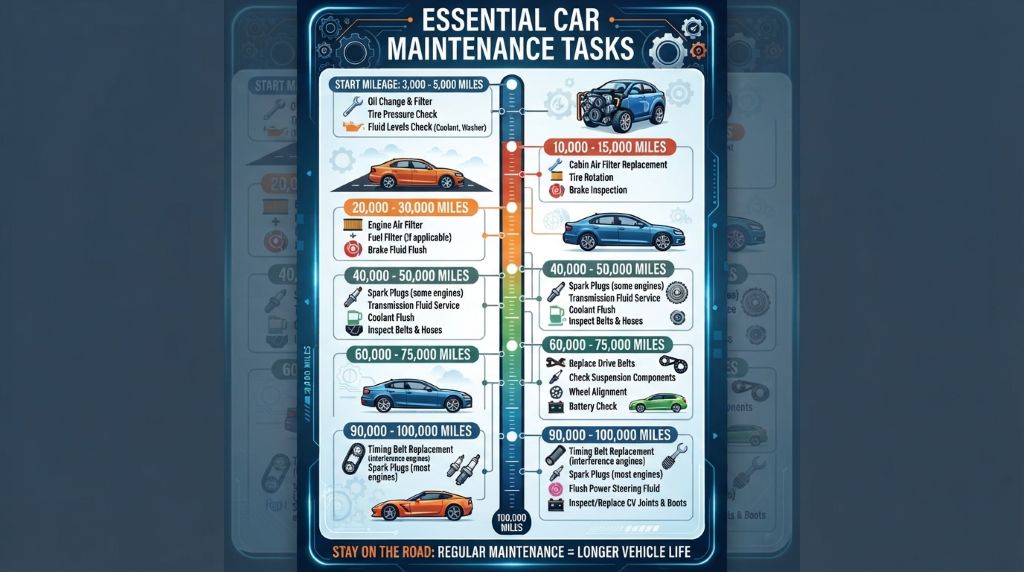
What to Check Between 5,000 and 25,000 Miles
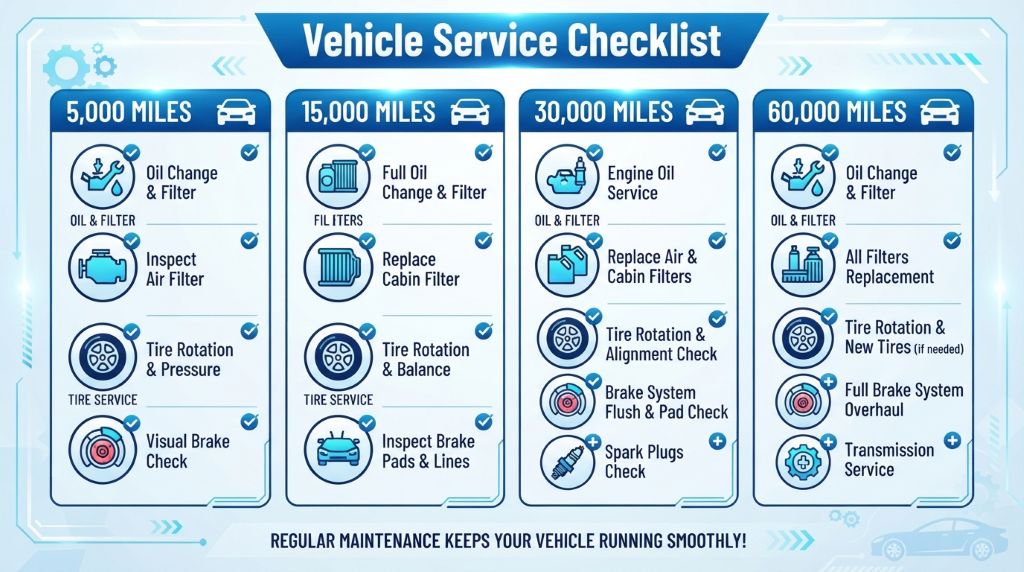
Early mileage service focuses on inexpensive, preventive basics. These tasks protect the engine and tires from unnecessary long-term wear.
- Oil and filter change every 5,000 to 7,500 miles.
- Tire rotation at matching intervals for even tread wear.
- Cabin and engine air filter inspection near 15,000 miles.
- Brake pad and fluid inspection around 20,000 miles.
- Fluid top-offs, including coolant and power steering fluid.
Oil changes during this window set the tone for engine longevity. Dirty or degraded oil loses lubricating ability, increasing friction between critical moving parts. Skipping even one change accelerates wear more than most drivers realize.
Tire rotation matters just as much, though it’s frequently overlooked. Uneven wear during these early miles shortens tire lifespan significantly. Rotating tires evenly also improves handling and slightly boosts fuel efficiency over time.
Brake inspections at this stage catch problems while they remain cheap fixes. Pads wear unevenly depending on driving style, terrain, and climate. A quick check now prevents rotor damage later, a repair that costs considerably more than a simple pad swap.
Setting a reminder every 5,000 miles turns this stage into a habit rather than a chore. That habit alone has kept every car I’ve maintained running smoothly well past six figures on the odometer.
What to Check Between 30,000 and 60,000 Miles
This stage introduces bigger, pricier components that demand closer attention. Ignoring this range often leads to the most preventable major repairs.
- Transmission fluid change, especially for vehicles towing or hauling regularly.
- Spark plug replacement to restore fuel efficiency and smooth acceleration.
- Brake pad replacement, typically needed by 40,000 to 50,000 miles.
- Battery testing, since most batteries last three to five years.
- Wheel alignment check, particularly after hitting potholes or curbs.
Spark plugs influence performance more than casual drivers expect. Worn plugs cause misfires, rough idling, and noticeably reduced fuel economy over time. Replacing them on schedule keeps combustion efficient and acceleration smooth.
Transmission fluid degrades under sustained heat and mechanical stress. Neglecting this service risks transmission failure, one of the costliest repairs a vehicle can face. A routine fluid change costs a small fraction of a full rebuild.
Battery health also becomes relevant during this mileage window. Batteries degrade slowly, then fail suddenly, usually without clear warning signs. Testing voltage output prevents the frustration of an unexpected no-start, especially during cold weather months.
What to Check Beyond 60,000 Miles
High mileage vehicles need closer attention to major systems that rarely announce trouble early. This stage protects against the most expensive repairs a car maintenance schedule aims to avoid.
- Timing belt replacement, typically between 60,000 and 90,000 miles.
- Coolant system flush to prevent overheating and internal corrosion.
- Suspension inspection, covering shocks, struts, and bushings.
- Fuel system cleaning to maintain efficient combustion.
- Drivetrain check for wear in CV joints and axle components.
Timing belt failure remains one of the most preventable disasters in car ownership. A snapped belt can destroy pistons and valves in interference engines instantly. Replacing it on schedule costs far less than engine reconstruction afterward.
Suspension wear also becomes noticeable around this mileage range. Worn shocks affect braking distance and stability on wet or uneven roads. Drivers often mistake gradual suspension wear for normal aging, delaying necessary repairs unnecessarily.
Adjusting the Schedule to Your Driving Habits
Standard mileage intervals assume average driving conditions, which rarely apply universally. Heavy towing, frequent short trips, or extreme climates all shift these numbers considerably.
Short trips prevent engines from reaching optimal operating temperature consistently. This pattern accelerates internal wear compared to longer highway drives. Drivers in this category should shorten oil change intervals slightly for better protection.
Towing or hauling regularly increases stress on transmission and cooling systems. Manufacturers often publish separate “severe service” schedules for exactly this reason. Checking your manual for these alternate intervals prevents premature component failure.
Final Thoughts
A car maintenance schedule organized by mileage removes guesswork from vehicle ownership entirely. Each stage targets the components most likely to fail at that specific point. Skipping stages doesn’t save money; it only delays and inflates the eventual bill. For more practical guidance on keeping your vehicle reliable, explore these essential car maintenance tips to extend the life of your vehicle and make routine care a more manageable part of ownership.
That squealing brake noise years ago still shapes how seriously I treat every mileage marker today. These numbers aren’t arbitrary; they reflect real, tested wear patterns across millions of vehicles. Respecting them keeps cars safer and considerably cheaper to maintain long term.
Share this schedule with someone due for service, or leave a comment about a mileage marker that saved you money. Real experiences help other drivers stay ahead of costly repairs.
Frequently Asked Questions
What is the single most important mileage marker to remember?
The timing belt replacement, usually between 60,000 and 90,000 miles, prevents catastrophic engine damage.
Does mileage matter more than vehicle age for maintenance?
Yes, wear comes from use, so mileage predicts component failure better than calendar age.
How do towing and short trips affect maintenance intervals?
Both increase stress on the engine and transmission, requiring shorter service intervals overall.
Can I skip transmission fluid changes if the car shifts smoothly?
No, smooth shifting doesn’t mean the fluid isn’t degrading internally over time.
Does following a strict mileage schedule really improve resale value?
Yes, documented mileage-based service history reassures buyers and typically raises resale price.